


If you’re in the business of making lithium-ion batteries, you already know the real battle isn’t just about energy density. It’s about consistency. And that battle is often won or lost long before the cells are assembled, right there in the grinding and dispersing stage.
I’ve spent a good chunk of my career watching how different grinding media perform under real-world conditions. When it comes to battery materials—things like LFP, NCM, or graphite—you need a grinding ball that does three things really well. It has to be hard enough to break down agglomerates without shattering. It has to be dense enough to deliver the right impact energy. And most importantly, it has to stay clean.
That last point is the one that keeps engineers up at night.
Even trace amounts of metal wear from the grinding media can cause micro-shorts inside a battery cell. You don’t see it right away. But later on, it shows up as self-discharge or, in a worst-case scenario, a safety issue. Based on my experience, this is where 99% alumina ceramic grinding balls really separate themselves from the pack.
Let’s break down why they work so well in battery production.
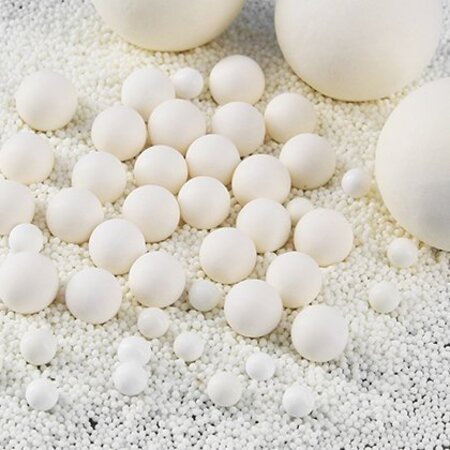
First, the purity level. When a ball is labeled “99% alumina,” it means the abrasive-resistant phase is almost entirely aluminum oxide. The remaining fraction is a carefully controlled sintering aid. What you don’t get are loose transition metals like iron or nickel that could leach into your slurry. For cathode materials, keeping that ionic purity high is non-negotiable. You’re not just grinding powder; you’re protecting the electrochemistry that happens later.
Second, the wear rate is incredibly low. I’ve run side-by-side tests comparing zirconia, steel, and 99% alumina media in a high-energy mill. The steel obviously gave the fastest grind, but the slurry turned gray. The zirconia performed well, but it’s much heavier and significantly more expensive. The alumina balls gave a very narrow particle size distribution, and when we measured the debris left behind, it was almost negligible. That translates directly to fewer filter changes and higher yields of usable material.
Third, there’s the practical matter of size availability. Battery slurries aren’t all the same. For initial mixing of coarse active material, you might want larger balls—say 10mm or 15mm—to crush the big chunks quickly. But for the final dispersion where you’re trying to coat nano-particles evenly on the surface, you need tiny beads. Some of the sizes in that range go down to 0.05mm. Having that range available means you can tune the whole milling process without switching to a completely different type of media halfway through.
You also have to consider the cost of ownership. Steel is cheap upfront, but it wears out fast and contaminates your product. Zirconia lasts longer, but the initial investment is steep. Alumina sits in the sweet spot. It lasts much longer than steel, often several times longer, and the upfront cost is reasonable enough that you can scale up a production line without blowing the equipment budget on consumables.
In a production environment, downtime is the enemy. If your grinding media starts cracking or rounding unevenly, it throws off the balance of the mill and you have to stop to screen it. With a well-made 99% alumina ball, the roundness is consistently rated above 95%. That matters because round media mills more evenly and puts less stress on the equipment’s mechanical seals and pumps.
So when I talk to process engineers who are setting up a new line for battery precursors, I usually ask them one question: are you optimizing for speed today, or for consistency over the next million cycles? If it’s the latter, high-purity alumina is usually the right call. It doesn’t try to do everything at once. What it does do—protecting purity, delivering consistent grind, and lasting through long production runs—is exactly what a battery line needs to stay profitable and reliable.
