


Let’s talk about cemented carbide. You know it as tungsten carbide. It’s brutally hard. Grinding it down into fine powder? That kills regular ceramic balls fast. I’ve seen plants try alumina. They fail. Zirconia? Better, but still wears out too quickly. And the contamination problem is real – you don’t want grinding debris messing up your carbide composition.
That’s where Silicon Carbide Ceramic Grinding Balls come in. They’re almost as hard as diamond. Not kidding. On the Mohs scale, SiC sits around 9.5. Diamond is 10. So when you’re milling something like WC‑Co (tungsten carbide with cobalt binder), these balls actually chew through the material instead of just bouncing around.
Based on my experience, the real win is purity. Hard alloy production demands ultra‑low contamination. Iron, chromium, even zirconia from regular balls can change your final product’s properties. Silicon carbide balls are chemically stubborn. They don’t react with acids or alkalis. They don’t shed metal bits. What you get is clean powder – and that means consistent hardness and toughness in your final carbide tools.
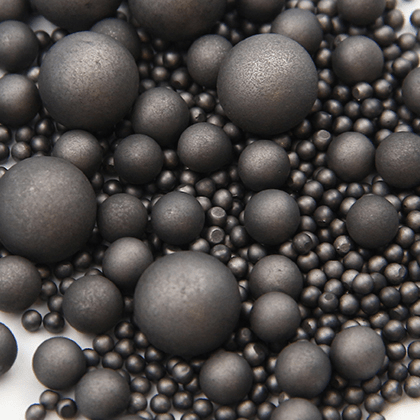
But here’s the catch. SiC balls are brittle. You can’t just throw them into a high‑speed stirred mill. They’ll crack. In our tests, running them over 3‑4 m/s tip speed in a small attritor led to visible breakage after 20 hours. So what works? Slower drum mills. Or vibratory mills with controlled amplitude. Think gentle but persistent grinding, not violent impact.
Another thing people overlook: matching the mill lining. If you use Silicon Carbide Ceramic Grinding Balls inside an alumina‑lined jar, the jar loses. Fast. The balls are harder, so they’ll wear down the lining and contaminate your batch with aluminum oxide. Best practice? Use a silicon carbide inner liner. Or at least a tough polyurethane coating.
So when should you choose these balls for hard alloy grinding? Three cases. First, you need sub‑micron carbide powder for ultra‑fine grade tools. Second, your product specs forbid more than 0.05% foreign oxides. Third, you’re processing recycled carbide scrap – that stuff has embedded hard particles that shred ordinary media.
One more practical tip. Don’t buy the cheapest SiC balls. Look for sintered α‑SiC grade, not reaction‑bonded. Reaction‑bonded contains free silicon. Free silicon acts like a soft spot. It will wear unevenly and contaminate your alloy with elemental Si. Sintered α‑SiC is uniform. Dense. And worth the extra cost.
To wrap up: Silicon Carbide Ceramic Grinding Balls are not a daily choice for every mill. They’re a specialized tool. For cemented carbide, they deliver speed, cleanliness, and longevity – but only if you run them right. Slow mill, hard liner, clean feed. Do that, and your powder will thank you.
