


Let’s talk about Zirconia Crucibles and their role in energy. It’s a fascinating area, and honestly, it’s where this material really gets to show off. When people hear “crucible,” they usually think about melting metal. But in the energy world, these crucibles play a different, more high-tech game.
The magic behind it all is a property called oxygen ion conductivity. At high temperatures, the crystal structure of zirconia, especially when it’s stabilized with something like yttria (you’ll see that 14% Y₂O₃ in the data sheet), allows oxygen ions to pass right through it. It becomes like a solid-state highway for oxygen.
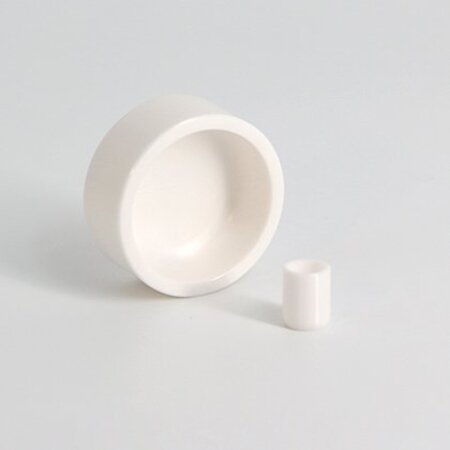
This leads to two big applications in energy.
First we will look at Solid Oxide Fuel Cells (SOFCs). These can be thought of as extremely efficient power plants, as they can convert fuels like natural gas or hydrogen (without combusting them) into electricity. In these, zirconia crucibles are commonly used as they serve as the electrolyte or the membrane that separates the fuel from the oxygen/air. The zirconia allows specific flow of oxygen ions to combine with the fuel, which generates an electric current. This process is clean and efficient.
In our tests, the stability of the material is what stands out most. A fuel cell needs to run for tens of thousands of hours, constantly cycling up and down in temperature. The crucible’s excellent thermal shock resistance (that low expansion coefficient in the data) is non-negotiable here; if the electrolyte cracks, the whole cell fails. They are an enabling technology, plain and simple.
Second, there are oxygen sensors. You might know these from car exhaust systems, but they’re also crucial for industrial process control. The sensor works on the same principle as the fuel cell. It uses a small piece of zirconia to compare the oxygen in a hot exhaust or process gas with a reference gas. The difference creates a voltage signal that tells you exactly how much oxygen is present. This is vital for optimizing combustion in power plants and keeping everything running efficiently and cleanly. The chemical inertness of the crucible material is key here—it has to survive in that harsh, corrosive exhaust environment for years without degrading.
Based on my experience, what makes Zirconia Crucibles so essential in these energy applications isn’t just one single property. It’s the combination. You need the high-temperature stability. You need the pure ionic conductivity. And you absolutely need the long-term durability in a tough environment. That combination is hard to find. They are a quiet workhorse, enabling cleaner power generation and smarter industrial processes.
