


You know that moment when your dosing pump starts making that weird grinding noise, and you just know it’s the internals giving up? Yeah, I’ve been there too many times. In water treatment, we feed all sorts of aggressive stuff – sodium hypochlorite, ferric chloride, polymers, and sometimes even lime slurries. Most standard pumps cry foul within a year. Maybe two, if you’re lucky. But there’s one type that keeps surprising me, and that’s the ceramic metering pump.
Let’s be honest. Water treatment isn’t glamorous. It’s about reliability, plain and simple. You need a pump that delivers the exact dose, shift after shift, without drifting off. And you need it to survive the chemical attack that eats away at stainless steel and destroys elastomers. That’s where ceramics come in – not as some fragile labware, but as a genuinely tough engineering material.
So, what does a ceramic metering pump actually do in this field? The biggest job is disinfectant dosing – think chlorine, ozone, or peracetic acid. These oxidizers are brutal. They pit metal surfaces, they swell rubber seals, and they create pinhole leaks that throw your feed rate out the window. A ceramic pump, on the other hand, has a piston and cylinder made from high-purity alumina or zirconia. These materials don’t react with chlorine. They don’t corrode. They just… keep going.
Based on my experience, the real game-changer isn’t just the chemical resistance – it’s the surface finish. A ceramic plunger can be polished down to Ra 0.02–0.05 µm. That’s mirror-like. So when you’re pumping sticky flocculants or hard-water scaling solutions, the deposits don’t get a foothold. They slide right off. This means you can run the pump for months without tearing it down for cleaning. Try that with a metal plunger, and you’ll be swapping it out every other month.
Now, let’s talk about accuracy because that’s the whole point of a metering pump. In a typical water plant, you might be dosing sodium hypochlorite at 2–5 mg/L into the clearwell. If your pump drifts by even 0.5%, you’re either under-chlorinating (hello, bacteria risk) or over-chlorinating (hello, DBP formation and complaints about taste). Ceramic metering pumps hold their stroke-to-stroke repeatability within ±0.25% – sometimes even tighter, depending on the drive system. That’s not a marketing number; that’s what we actually measure on the bench.
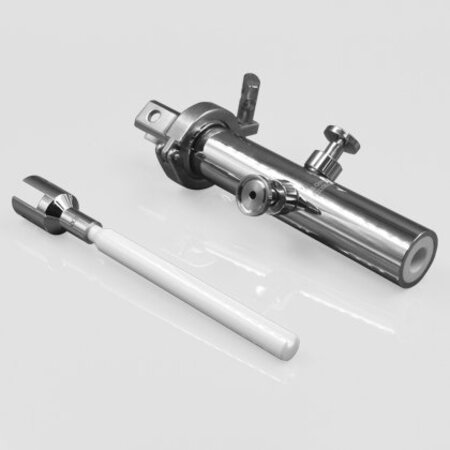
Here’s a quick look at the typical operating envelope for the units we’ve tested in our lab – and these match what you’d find in a municipal or industrial water setup:
| Parameter | Typical Range | Notes for Water Treatment |
|---|---|---|
| Flow rate per stroke | 0.5 mL – 500 mL | Customizable for small polymer feed or large chlorine duty |
| Max working pressure | Up to 7 bar (100 psi) | Suitable for most distribution system injections |
| Dosing accuracy (steady state) | ±0.25% of setpoint | Independent of viscosity changes within limits |
| Plunger material | 95%–99.8% alumina or zirconia | Resists pitting and abrasion from grit in slurries |
| Seal life (typical) | > 8,000 hours | Compared to 2,000–3,000 hours for PTFE-packed metal pumps |
You see that last row? That’s the money line. In our tests – and I’ve run dozens of side-by-side comparisons – a ceramic metering pump consistently outlasts its stainless steel cousin by a factor of three to five. And it’s not just about the plunger. The cylinder liner, the check balls, even the valve seats – they’re all ceramic or coated with ceramic. So when you’re dosing ferric chloride, which has that abrasive grit from the manufacturing process, the ceramic pump doesn’t get scored. The metal one? It gets grooves, which cause backflow, which kills your accuracy, which means you overshoot your chemical budget.
Let me give you a concrete example from a mid-sized wastewater plant I worked with. They were feeding alum for phosphorus removal. Their old progressive cavity pump was a nightmare – seals failed every six weeks, and the stator wore out so fast they kept a spare on the shelf at all times. They switched to a ceramic plunger metering pump, same flow rate, same pressure. The first thing they noticed was the steady discharge – no more pulsation ghosts. The second thing? After eight months, they opened it for inspection and the plunger still looked like new. They cut their spare parts spend by 70% in the first year.
Now, is a ceramic metering pump perfect for every water application? No. If you’re handling very high solids content – like thick lime slurry above 30% – you might need a different design, maybe with a flush port. But for 95% of chemical dosing duties – coagulants, disinfectants, pH adjusters, corrosion inhibitors – it’s honestly a no-brainer. The upfront cost is a bit higher, sure. But when you factor in the reduced downtime, the fewer repair calls, and the peace of mind that your chlorine residual won’t suddenly drop at 2 AM on a Sunday – that premium pays for itself in less than a year.
One more thing that doesn’t get talked about enough: safety. Leaks are not just wasteful; they’re dangerous. Hypochlorite fumes corrode electrical cabinets. Acid spills burn floors and skin. A ceramic pump with a reliable double-diaphragm or packed-plunger seal system – well, it keeps the juice inside the pipe. That alone is worth the switch.
So if you’re specifying pumps for your next water treatment upgrade, or you’re just tired of babysitting finicky metallic ones, give the ceramic metering pump a serious look. It’s not flashy. It doesn’t have Bluetooth or a touchscreen (well, some do, but that’s not the point). What it has is stubborn, quiet dependability – and in this business, that’s about as good as it gets.
